
If you’d told me this time last week that Jensen Huang was about to leave Nvidia, I probably wouldn’t have believed you.
The man who co-founded one of the most successful technology companies in history, spent more than three decades building it from the ground up, and steered it through some difficult periods has now resigned from the company he helped create.
And the circumstances surrounding his departure are extraordinary.
On Thursday, November 12, Nvidia announced that Jensen Huang had resigned as its president, CEO and a member of the board of directors, effective immediately.
After 33 years at the helm, one of the most recognizable faces in technology is leaving the company that has become central to the global AI revolution.
His departure comes just days after Nvidia’s board announced an independent investigation following reports about Huang’s personal relationships and possible national security implications.
The controversy began with reports about Alice Huang, a businesswoman and former executive at Singapore-based Megaspeed.
US intelligence officials reportedly suspected that she had links to China’s Ministry of State Security and may have been involved in an intelligence operation targeting Jensen Huang.
Huang subsequently acknowledged being unfaithful to his wife in a message to Nvidia employees, apologizing to his family and colleagues.
A separate report also alleged an intimate relationship with Kimberly Powell, Nvidia’s vice president of healthcare, who reportedly worked under him.
These revelations placed Nvidia in an uncomfortable position, particularly given its importance to US national security and the geopolitical competition surrounding advanced AI chips.
The company’s board initially expressed confidence in Huang while announcing an independent investigation overseen by outside legal counsel.
However, that position changed as further reports emerged and the board considered his future.
Nvidia has not publicly stated that the allegations were the specific reason for his resignation, so it’s important to separate the confirmed departure from the unresolved questions surrounding the investigation.
Still, the timing has made this one of the most significant leadership developments in the technology industry this year.
Who takes over from Jensen Huang?

Colette Kress, who takes over for now, will probably be a familiar name to anyone who regularly follows Nvidia’s financial performance.
Colette Kress, the company’s longtime chief financial officer, has been appointed interim CEO while the board searches for a permanent replacement.
Kress joined Nvidia in September 2013 and has spent more than 13 years overseeing its finances through an extraordinary period of growth.
Before joining Nvidia, she held senior finance positions at companies including Microsoft and Cisco.
She has also regularly appeared alongside Huang during Nvidia’s quarterly earnings calls, explaining the company’s financial performance and answering questions from investors.
Her appointment provides some continuity during an uncertain period, especially because she already understands Nvidia’s financial operations, customers and business strategy.
However, leading a company of Nvidia’s size comes with responsibilities that go well beyond managing its finances.
Huang was deeply involved in Nvidia’s technology vision, product development and long-term strategy. His leadership helped transform the company from a graphics chip manufacturer into the supplier of much of the computing infrastructure powering modern AI.
Kress will have to demonstrate that Nvidia can maintain that momentum under different leadership.
The board has said it will consider both internal and external candidates when selecting a permanent CEO.
Longtime director Harvey C. Jones has also been appointed Nvidia’s first-ever chairman of the board.
Why this matters to the entire AI industry
Here’s where things get particularly interesting.
Nvidia is currently one of the most important companies in the AI ecosystem.
Its graphics processing units (GPUs) power the data centers used to train and run some of the world’s most advanced AI models.
Companies like OpenAI, Anthropic, Google and Microsoft depend heavily on Nvidia’s hardware to support their AI operations.
And the demand for that computing power has helped turn Nvidia into a company worth trillions of dollars.
For more than three decades, Huang was the person driving that vision.
He became closely associated with Nvidia’s strategy, its engineering culture and its aggressive approach to developing new computing technologies.
Now, investors and industry leaders have to consider what happens when that person leaves.
Will Nvidia continue executing its existing product roadmap at the same pace?
Can the company maintain its relationships with major AI customers?
Will a new CEO make different decisions about its investments, partnerships and expansion?
These are important questions because Nvidia’s decisions affect much more than its own shareholders.
A prolonged leadership disruption could create uncertainty for companies building their AI infrastructure around Nvidia’s technology.
At the same time, Nvidia has said its operations, customer commitments and product roadmap will continue during the transition.
The company is also scheduled to release its quarterly earnings on November 17, which will give investors another opportunity to assess its business performance.
One thing is certain. The next few months will be an important period for Nvidia.
And for Jensen Huang, the man who spent 33 years building the company, this marks the end of an extraordinary chapter.
But while the Nvidia story is unfolding, there’s another development worth paying attention to.
The amount of information we’re expected to process every day is increasing rapidly, especially as AI continues to evolve.
And that brings me to something I think everyone should learn how to build.
How to build a Second Brain with Claude
Think about how you consume information every day.
You open LinkedIn and discover an interesting AI development.
You read an article about a company raising millions of dollars.
Someone shares a useful prompt.
You save a research paper, watch a YouTube video or bookmark a tutorial you intend to revisit.
Then you move on to the next thing.
A few days later, you remember reading something interesting, but you can’t remember where you saved it.
You might even remember the headline without remembering the actual information.
This is a problem many people experience, especially when they’re constantly learning new things.
The solution is to build what’s called a Second Brain.
A Second Brain is essentially an external knowledge system that helps you capture, organize, retrieve and connect information.
Think of it as a personal library that grows with everything you learn.
And you can build one using Claude.
STEP 1: Create your knowledge workspace
You might already know Claude as an AI chatbot.
You ask it questions, generate content, analyze documents or write emails.
But one of its most useful features for this particular workflow is Claude Projects.
Projects allow you to create dedicated workspaces with their own instructions and knowledge bases.
You can upload documents, articles, research papers, notes and other resources.
Claude can then reference those materials across conversations within the project.
This means you don’t have to explain your background or upload the same documents every time you start a new conversation.
Here’s how to get started.
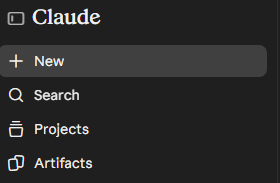
Open Claude Projects.
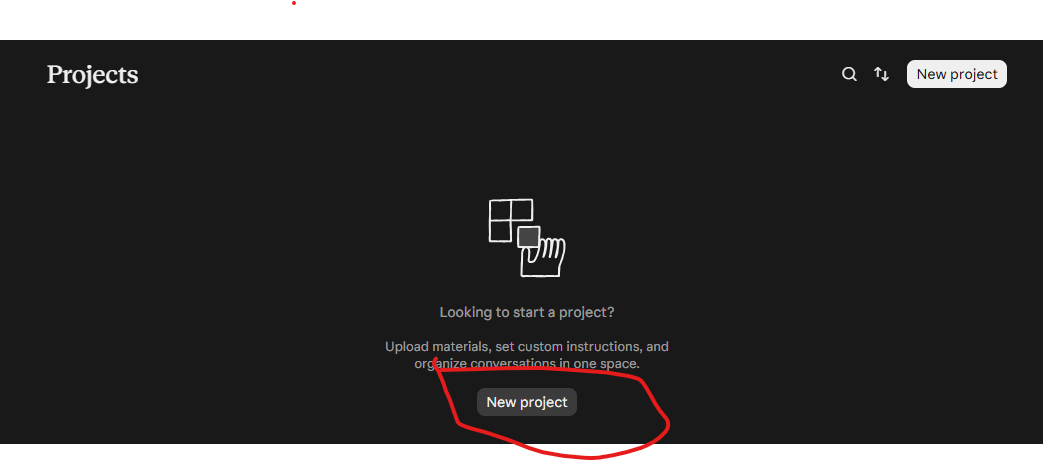
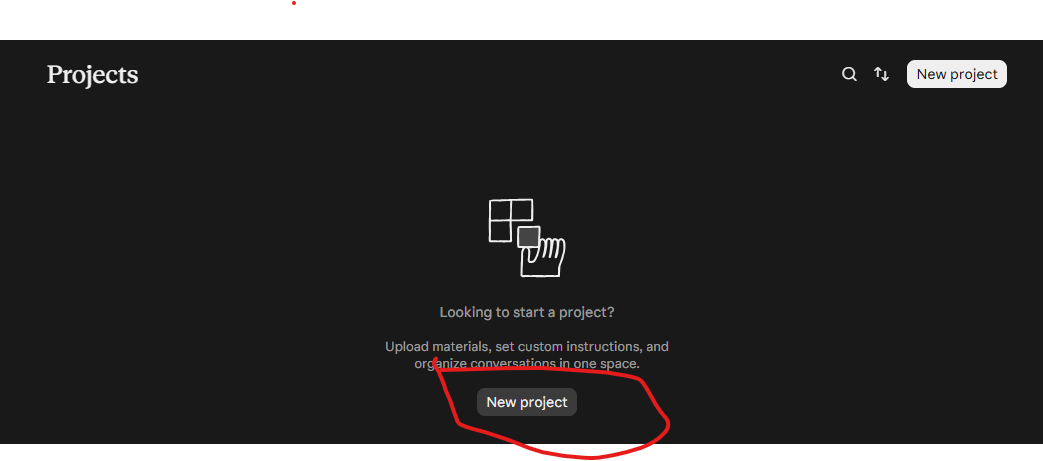
Click New Project.
3. Give your project a name. For this example, use “My Second Brain”.

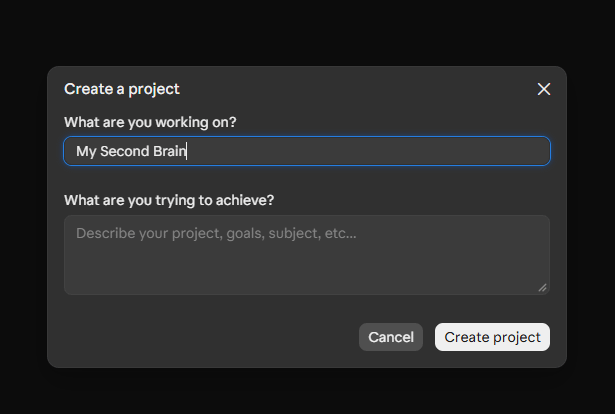
Add a short description explaining what you want the project to help you achieve.
You can use one project for everything or create separate projects for different areas of your life.
For example:
AI and Technology
Business and Startups
Marketing and Content Creation
Career and Professional Development
Personal Learning
The goal is to give useful information a home instead of scattering it across different conversations and folders.
STEP 2: Give Claude instructions
This is where prompting becomes important.
You don’t want Claude to behave like a chatbot that simply summarizes every document you upload.
You want it to act as your personal research assistant, knowledge manager and thinking partner.
Go to your project’s instructions section and paste this prompt.
THE SECOND BRAIN PROMPT
“You are my personal knowledge management assistant.
Your job is to help me capture, organize, understand and retrieve information from the documents, articles, research papers and notes I add to this project.
Follow these principles:
ORGANIZE: Identify the main topics, concepts, people, companies and ideas in every document I share.
SUMMARIZE: Extract the most important insights without losing the original meaning or important context.
CONNECT: Compare new information with existing knowledge in this project. Identify related ideas, recurring patterns, contradictions and developments.
QUESTION: Highlight assumptions, unanswered questions and areas where further research would be useful.
RETRIEVE: When I ask a question, search the available knowledge in this project and provide answers grounded in the source material.
EXPLAIN: Break down complicated concepts into simple language without sacrificing accuracy.
APPLY: Show me how the information can be applied to my work, business, learning or decision-making.
IMPORTANT RULES:
Never invent facts or present assumptions as verified information.
Distinguish between facts, opinions and speculation.
When possible, identify the source of important claims.
If information is missing, tell me instead of guessing.
Preserve useful details, dates, statistics and names.
Your goal is not just to help me collect information. It’s to help me develop a deeper understanding of what I learn.”
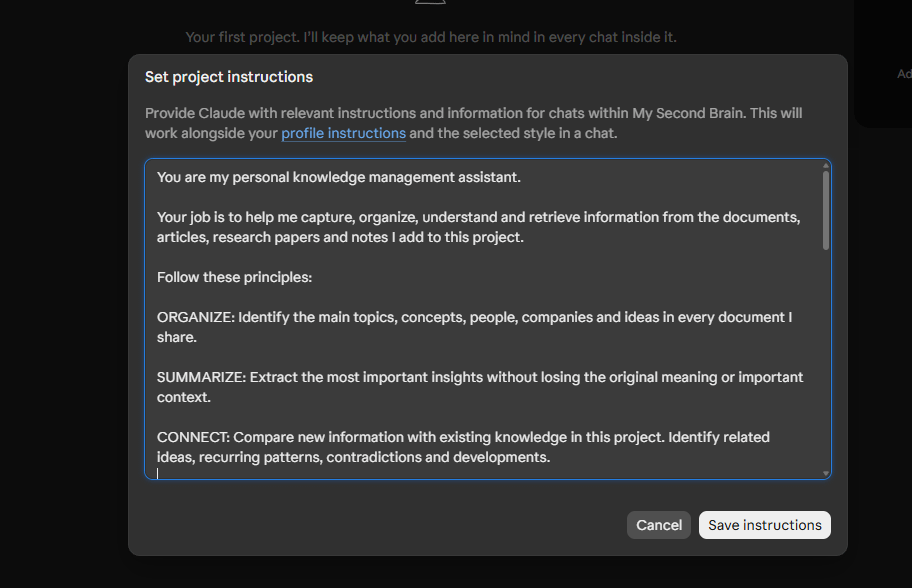
Save these instructions.
You’ve now given Claude a specific role and a consistent way to process information.
STEP 3: Start feeding your Second Brain
This is where the system becomes useful.
Whenever you come across something worth keeping, add it to your project.
For example:
An interesting article about Nvidia.
A PDF containing AI research.
A transcript from a YouTube video.
Your notes from a book.
A report about a company.
A useful LinkedIn post.
An idea you want to explore later.
Claude supports different document formats, including PDF, DOCX, CSV and TXT.
You can upload files directly into your project’s knowledge base.
But here’s a prompting trick.
Don’t just upload a document and move on.
Give Claude a specific instruction about what you want to extract from it.
Try this:
PROMPT 2: THE KNOWLEDGE EXTRACTION PROMPT
“Analyze the document I’ve just uploaded.
I don’t want a generic summary.
Extract the following:
The five most important ideas.
Important facts, statistics and supporting evidence.
The companies, people and technologies mentioned.
The key arguments and conclusions.
Anything that challenges what I previously believed.
Three practical lessons I can apply.
Questions this document raises that deserve further investigation.
Then identify connections between this document and other materials already in my Second Brain.
Where possible, reference the source document and distinguish its claims from your own analysis.”
This turns passive reading into active learning.
Instead of simply knowing that you read something, you begin to understand what it means.
STEP 4: Use Claude to connect the dots
This is arguably the most interesting part.
Imagine you’ve saved 10 articles about Nvidia, OpenAI, Google, Anthropic and the broader AI infrastructure market.
Individually, each article tells you something.
But together, they could reveal a much bigger picture.
For example, you might notice that several companies are investing billions of dollars in data centers.
You might discover that their biggest constraint isn’t access to AI models but the infrastructure required to run them.
You might connect Nvidia’s GPU dominance with the growing competition around custom AI chips.
These connections are where deeper understanding begins.
Try this prompt:
PROMPT 3: THE CONNECTION FINDER
“Review the information available in my Second Brain.
Identify five important connections between different documents, articles or ideas I’ve saved.
For each connection:
Explain the ideas being connected.
Identify the supporting sources.
Explain why the connection matters.
Highlight any emerging trend or pattern.
Tell me what I might be overlooking.
Don’t force connections where none exist.
Prioritize insights that would be difficult to notice by reading each document individually.”
This is particularly useful when researching industries, companies, markets or emerging technologies.
STEP 5: Turn your knowledge into something useful
Here’s where your Second Brain moves beyond storing information.
You can use it to produce actual work.
For example, you could ask Claude to:
Prepare a briefing before an important meeting.
Help you understand a new industry.
Generate content ideas from your research.
Compare competing companies.
Prepare a presentation using your saved documents.
Identify business opportunities from emerging trends.
Create a personalized learning plan around a subject.
Here’s one final prompt worth saving:
PROMPT 4: THE THINKING PARTNER
“Act as my personal research and thinking partner.
Based on the information in my Second Brain, help me explore the following topic:
[INSERT TOPIC]
Don’t just give me a surface-level explanation.
Connect relevant information from my existing knowledge, identify important patterns, challenge my assumptions and show me what I should investigate next.
Structure your response into:
What I already know.
What the available information suggests.
Important connections and patterns.
What I might be missing.
New questions worth exploring.
Practical actions I can take.
Use my saved sources wherever possible. Clearly identify when you’re introducing information that isn’t contained in my knowledge base.”
You now have a system that can help you move from collecting information to developing your own understanding.
A final thing to remember
A Second Brain isn’t something you build in one afternoon and forget about.
It’s a system you maintain.
Spend 10–15 minutes a day adding useful information, reviewing what you’ve learned and asking better questions.
And don’t upload everything you come across.
Be selective.
A library filled with thousands of random documents isn’t necessarily useful.
The goal is to build a collection of information that helps you think better.
Also, remember that Claude can make mistakes. Always verify important claims against the original sources, especially when dealing with financial, legal or business decisions.
The Nvidia story is a good example of why this matters.
A headline tells you that Jensen Huang has resigned.
But understanding what that means for the AI industry requires connecting several different things.
Nvidia’s position in the AI supply chain, its relationships with major technology companies, the importance of its leadership and the geopolitical competition surrounding advanced AI chips.
You need to understand how these developments relate to one another before you can form a meaningful view of what’s happening.
And that requires more than simply reading headlines.
It requires building knowledge over time, asking better questions and learning to connect the dots.
Claude can help you do that.
The more deliberately you use it, the more useful your Second Brain becomes.
Thank you for reading today’s edition. See you in the next one