Welcome back to The Breakdown AI.
Another week, another batch of headlines that prove the AI space never really slows down.
OpenAI dropped a new model, Claude quietly became the most downloaded app in the US, Netflix got into the AI filmmaking business, and a senior OpenAI researcher decided he’d rather work for the competition.
A lot happened.
So……. Let’s get to it, shall we?
Here’s what we’re covering today:
OpenAI launches GPT-5.4 with Pro and Thinking versions
Claude’s user growth explodes after the Pentagon deal fallout
OpenAI’s VP of Research quits and joins Anthropic
Netflix acquires Ben Affleck’s AI filmmaking company
How to use Claude to write a cold email that actually gets a reply
Trending AI tools you should know about
Image source: TechCrunch
OpenAI launches GPT-5.4 with Pro and Thinking versions
OpenAI released GPT-5.4 this week, pitching it as its most capable and efficient model yet for professional work.
It comes in three flavors: a standard version, a reasoning-focused Thinking version, and a high-performance Pro version.
The API supports context windows up to 1 million tokens, the largest OpenAI has ever offered.
The Breakdown: Beyond the raw performance numbers, two things stand out.
First, GPT-5.4 is 33% less likely to make errors in individual claims compared to GPT-5.2, which is a real improvement if you use AI for anything that requires accuracy.
Second, OpenAI introduced a new Tool Search system that changes how the model handles tool calling. Instead of loading every tool definition upfront, which eats into your token budget, the model now looks up tools only when it needs them. That's a smart efficiency fix, especially for developers building complex AI agents.
Why it matters: This release is not just a capability upgrade. It’s OpenAI signaling that it’s building for professionals and developers who need reliability and scale, not just general consumers. The benchmark results in law and finance specifically are worth paying attention to. That’s a market with serious money in it.
Claude's user growth explodes after the Pentagon deal fallout
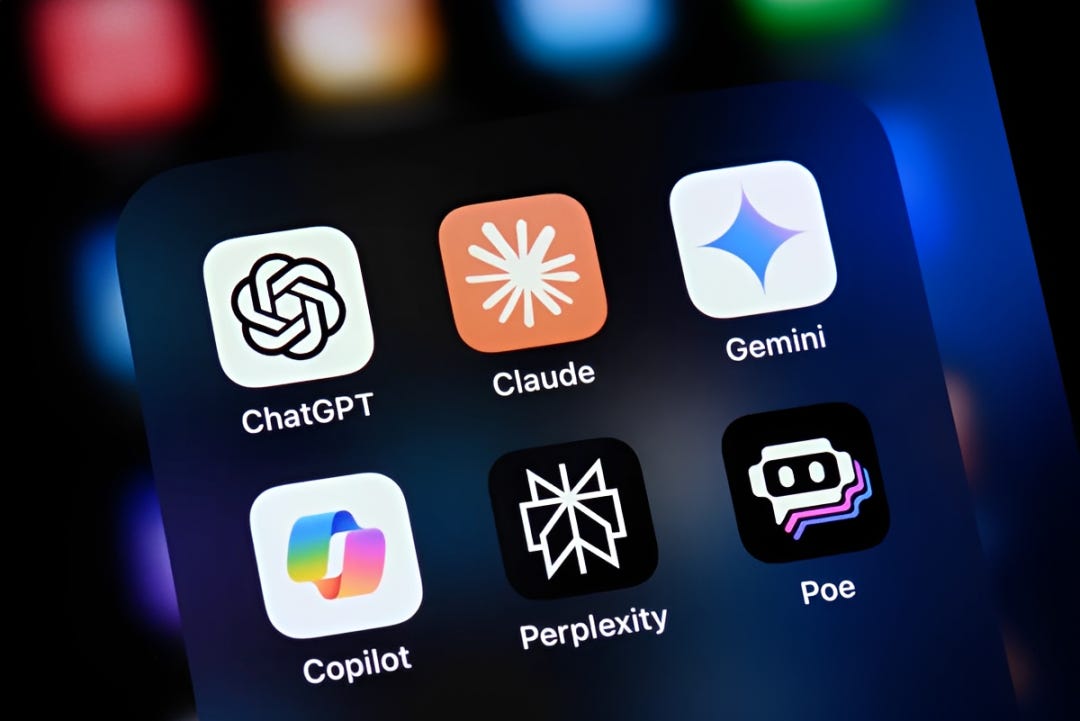
After Anthropic’s public standoff with the Pentagon, Claude became the number one app on the US App Store and is holding that position.
Daily downloads hit 149,000 on March 2, ahead of ChatGPT’s 124,000.
Daily active users on mobile reached 11.3 million, up 183% since the start of the year. Paid subscribers have doubled.
The Breakdown: Anthropic took a hit politically. The White House called them out, the Pentagon labeled them a supply-chain risk, and it looked bad in the short term.
But consumers responded in the opposite direction.
When Anthropic CEO, Dario Amodei drew a line around mass surveillance and autonomous weapons, a significant chunk of the public rewarded that stance with their attention and their downloads. That’s unusual in tech, where principle usually costs you.
Why it matters: It shows that AI companies are now operating in a trust economy, not just a features economy. Claude’s surge isn’t purely because it got better as a product. It happened because Anthropic made a values-based decision in public and people noticed. Whether that growth sticks long term depends on whether the product keeps up with the momentum.
OpenAI's VP of Research resigns and joins Anthropic
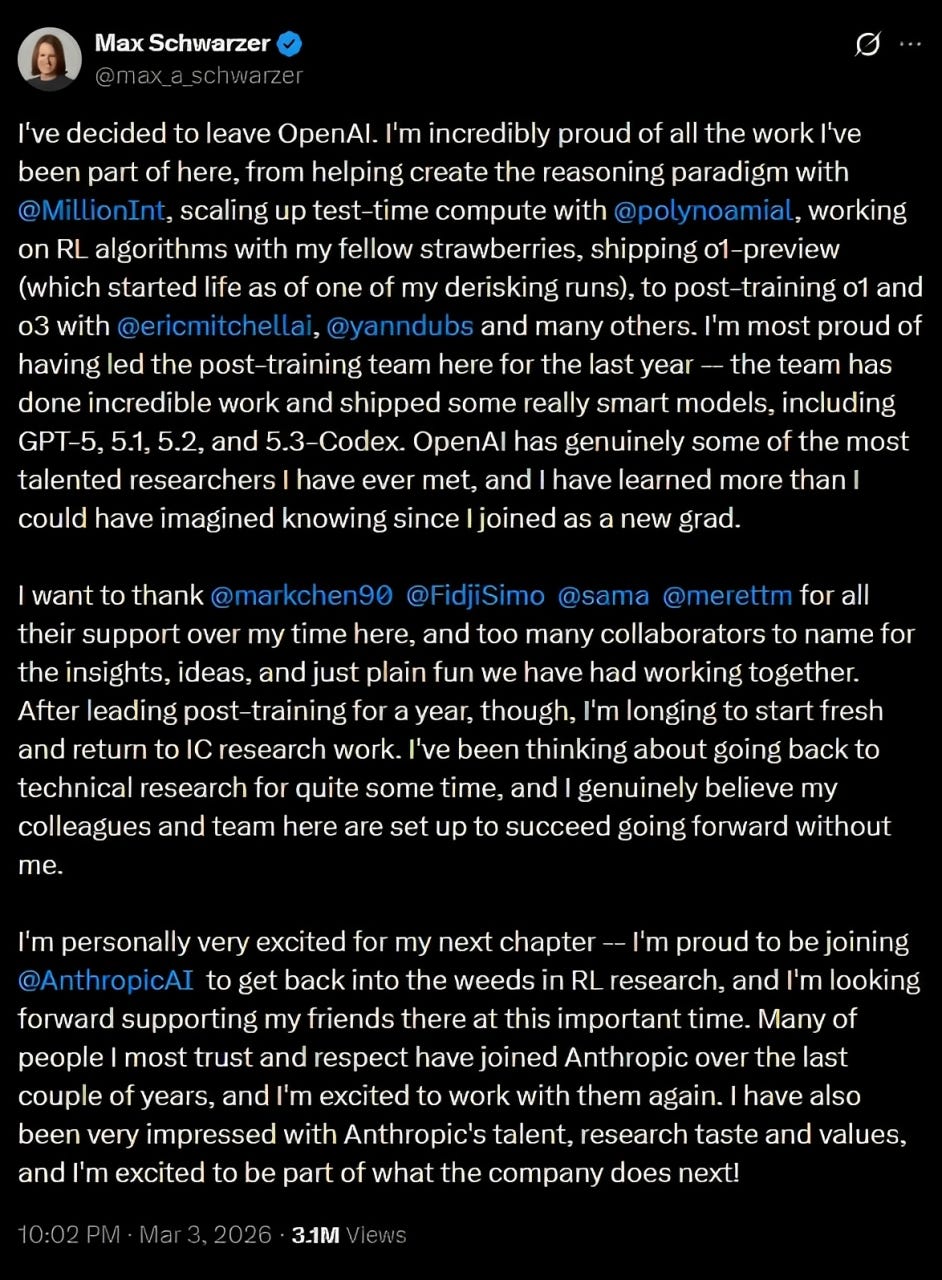
Max Schwarzer, who led post-training research at OpenAI and worked on improving reasoning across several of the company’s recent models, has left to join Anthropic. His work was directly tied to making OpenAI’s models smarter and more scalable.
The Breakdown: Post-training is where a lot of the real differentiation happens in AI models. It's the stage that shapes how a model reasons, how it handles edge cases, and how well it scales.
Losing someone who worked on that at a senior level is not trivial. And the fact that he went specifically to Anthropic, right as Claude is having its biggest growth moment, makes the timing interesting.
Why it matters: Talent movement in AI tells you a lot about where people think the momentum is. This is one researcher, but it adds to a broader narrative that Anthropic is becoming a more attractive destination for serious AI researchers, not just a principled alternative to OpenAI.
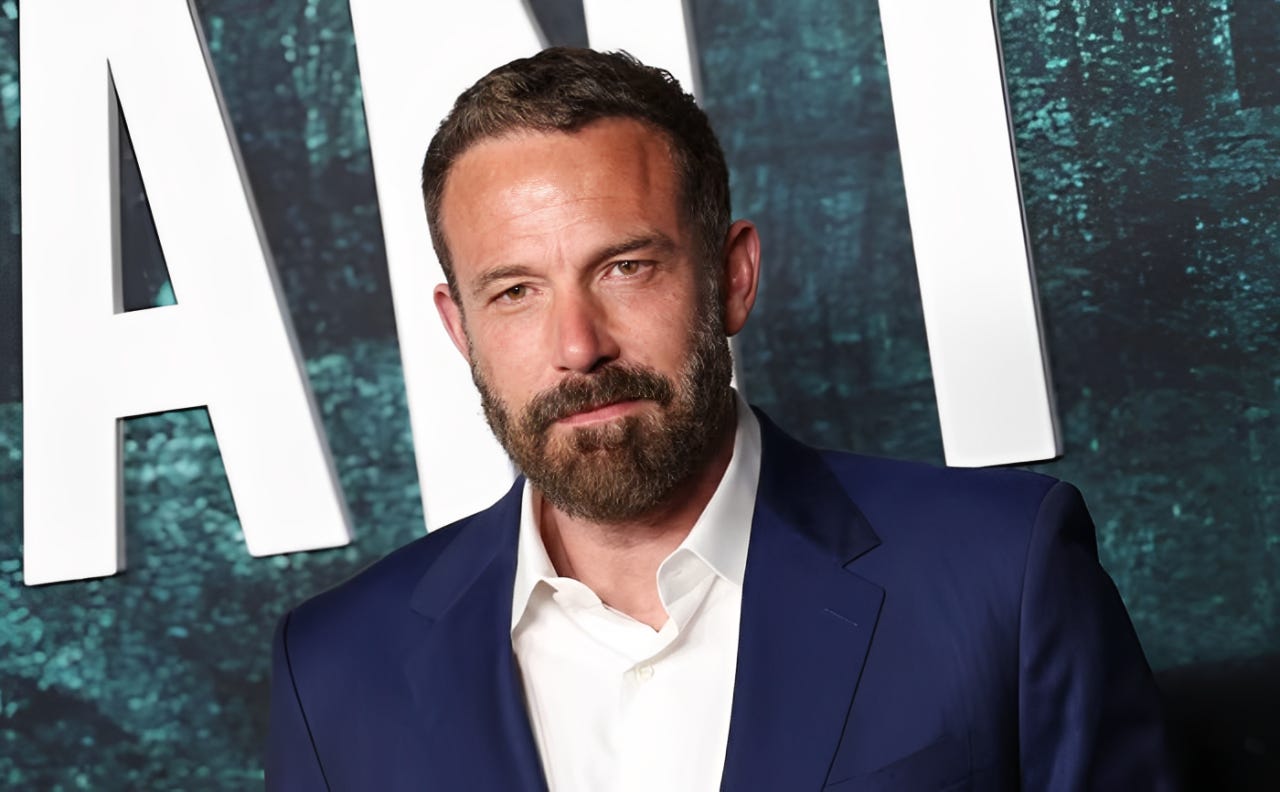
Netflix acquires Ben Affleck's AI filmmaking company InterPositive
Netflix has acquired InterPositive, an AI filmmaking technology company that Ben Affleck founded in 2022.
The company built a model that helps production teams work with their own footage to fix post-production issues like continuity errors, lighting problems, and background adjustments. Affleck is joining Netflix as a senior adviser.
The Breakdown: What's notable here is what InterPositive is not doing.
It's not building AI actors or synthetic performances. It's building tools that give human editors more control, not less.
That's a deliberate framing, and Netflix leaned into it in their statement too.
The acquisition is partly a product move but it's also a PR move.
Netflix is telling filmmakers, crew members, and critics that its approach to AI is about empowering the creative process, not automating it away.
Why it matters: Hollywood has been watching how streamers approach AI very closely, and this deal sends a message. Netflix is essentially paying to be on the right side of that conversation. Expect other studios and platforms to make similar moves in the coming months to stake out their position before the debate gets louder.
HOW TO USE CLAUDE TO WRITE A COLD EMAIL THAT ACTUALLY GETS A REPLY
Cold emails fail for one reason.
They are written for the sender, not the recipient. Claude can help you flip that.
Here is a simple workflow that takes about 15 minutes and produces a cold email worth sending:
Step 1. Define exactly what you want and who you're sending to
Context setup prompt:
“I want to write a cold email to [RECIPIENT NAME or ROLE] at [COMPANY]. My goal is to [SPECIFIC OUTCOME, e.g. book a 20-minute call, pitch a collaboration, apply for a role]. Here is what I know about them: [ANYTHING RELEVANT]. Here is a bit about me: [YOUR BACKGROUND]. Keep this in mind as I build out the email.”
Step 2. Build the hook
The first line decides whether the email gets read or deleted. Ask Claude to give you several options so you can pick the one that fits your tone.
Opening line prompt:
"Write 5 different opening lines for this cold email. Each one should be specific to the person, relevant to what I want, and short enough to read in under 5 seconds. Avoid starting with 'I hope this finds you well' or anything like it. No flattery, no fluff."
Step 3. Write the full email
Once you have an opening you like, ask Claude to write the full thing. Keep the target length in mind because shorter is almost always better with cold outreach.
Full email prompt:
“Now write the full cold email using opening line number [X]. Keep the total length under 120 words. Make the ask clear and easy to say yes to. End with one specific call to action. Do not use jargon or buzzwords.”
Step 4. Stress-test it
Before you hit send, have Claude read it back as the recipient and tell you honestly whether it lands.
Recipient review prompt:
“Now read this email as the person receiving it. What would their first reaction be? Is the ask clear? Does anything come across as pushy, vague, or self-serving? Give me honest feedback and then rewrite any weak parts.”
That's the workflow.
Four steps, one solid cold email.
The difference between Claude doing this and doing it yourself is that Claude won't let you get away with vague language or a weak ask. It will call it out if you ask it to.
TRENDING TOOLS
Five tools worth looking at this week:
An async video tool that records meetings, generates transcripts, and lets your team leave comments at specific timestamps. Good for teams that are tired of sitting through calls that could have been a short clip.
An AI presentation builder that turns your notes, docs, or prompts into clean slide decks. It focuses on keeping the layout professional without you having to touch a single design setting.
An AI-powered testing tool built for software teams. It writes and runs tests based on plain English descriptions of what your app should do. Useful if you want test coverage without spending hours writing test scripts.
Luma generates high-quality video from text prompts or images. It has become a go-to for creators who want cinematic-looking video clips without a production budget.
An AI-powered coding environment that lets you build, run, and deploy apps directly in the browser. Great for non-developers who want to ship something without setting up a local environment.
Thank you for reading today’s edition. See you next time!