

Whenever we talk about AI, the conversation usually revolves around the models.
Is ChatGPT getting smarter? Is Claude better at coding? Can Gemini handle more complicated tasks?
But there’s a much bigger business happening behind those products.
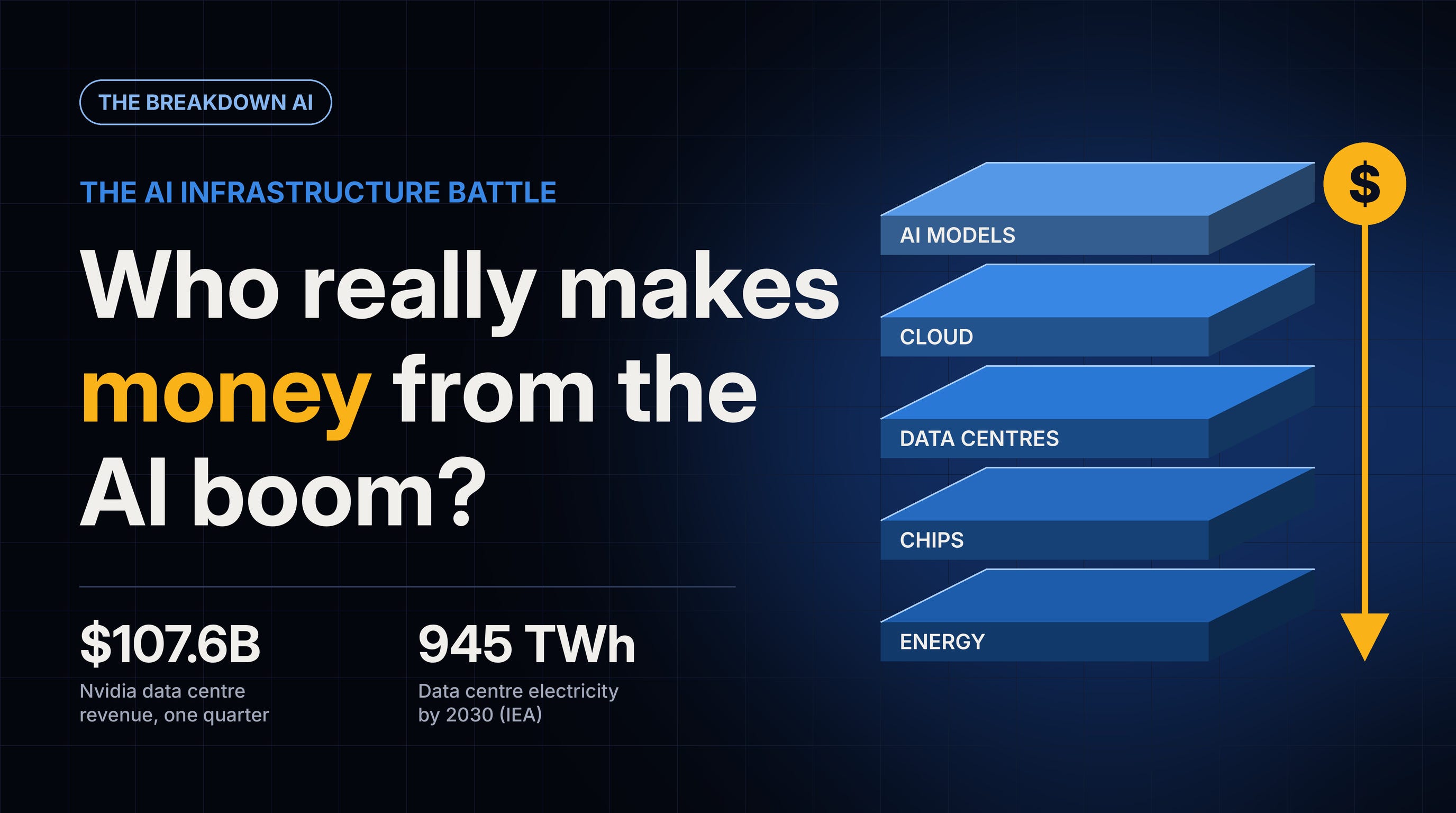
Every time you use an AI assistant, there’s an entire infrastructure system working behind the scenes. Specialised chips process your requests, data centres house those chips, electricity keeps everything running, and cloud providers make the computing power available to AI companies.
And someone has to pay for all of it.
This infrastructure business is becoming one of the biggest battlegrounds in technology.
Amazon, Microsoft, Google and other major technology companies are committing enormous sums to expand their computing capacity. Nvidia is generating record revenue from AI hardware, while China is fighting to secure access to advanced chips.
Meanwhile, electricity is becoming a serious constraint, and the cost of running AI models could determine which companies actually make money from this boom.
There’s also the Jensen Huang controversy, which has brought Nvidia’s relationship with China and US export restrictions into an even bigger political spotlight.
I want to break down how this infrastructure business works, where the money flows and what I’d be watching over the next year.
Get in-depth industry analysis, practical AI playbooks, tested prompts, and guides to help you work, learn, and build with AI.
Inside you’ll find:
Why AI demand keeps driving up the need for computing power.
How Nvidia, AMD, cloud providers and AI companies make money.
Why China is fighting for access to advanced chips and how US restrictions are changing the market.
What the Jensen Huang controversy means for Nvidia.
Why electricity and data centre capacity are becoming major bottlenecks.
How falling inference costs could reshape the AI industry.
A breakdown of the AI infrastructure value chain and where the money flows.
Let’s start with the most important piece of the puzzle.